llama.cpp
GGUF engine, native libraries, format tooling and optional server transport.
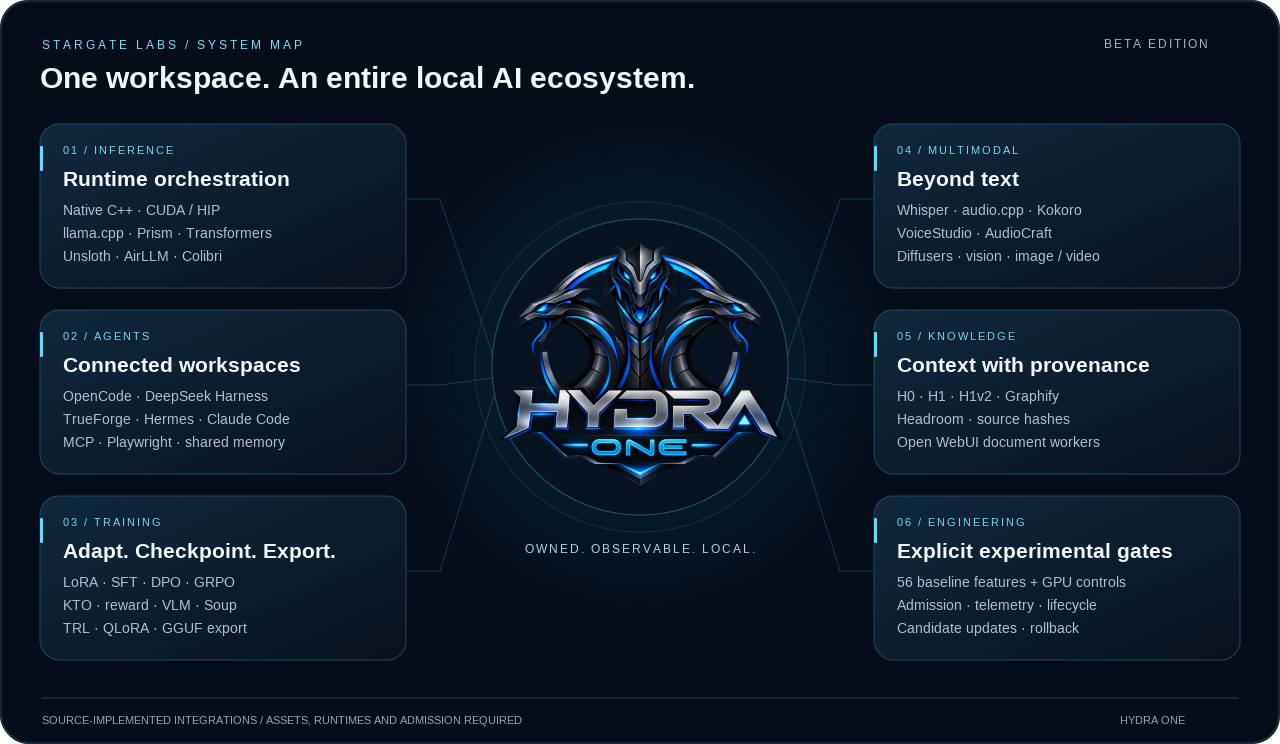
La nostra versione beta: integrazione HYDRA One, modelli locali e un laboratorio per osservare e controllare il runtime.
Hydra One nasce per riunire il lavoro che altrimenti resterebbe distribuito tra interfacce e runtime diversi: chat, cataloghi, documenti, strumenti, agenti, training e produzione multimodale. Il nostro contributo è il collegamento fra questi percorsi, con selezione dei componenti, stato leggibile e proprietà dei processi. Le app originali mantengono i propri contratti e la loro attribuzione.
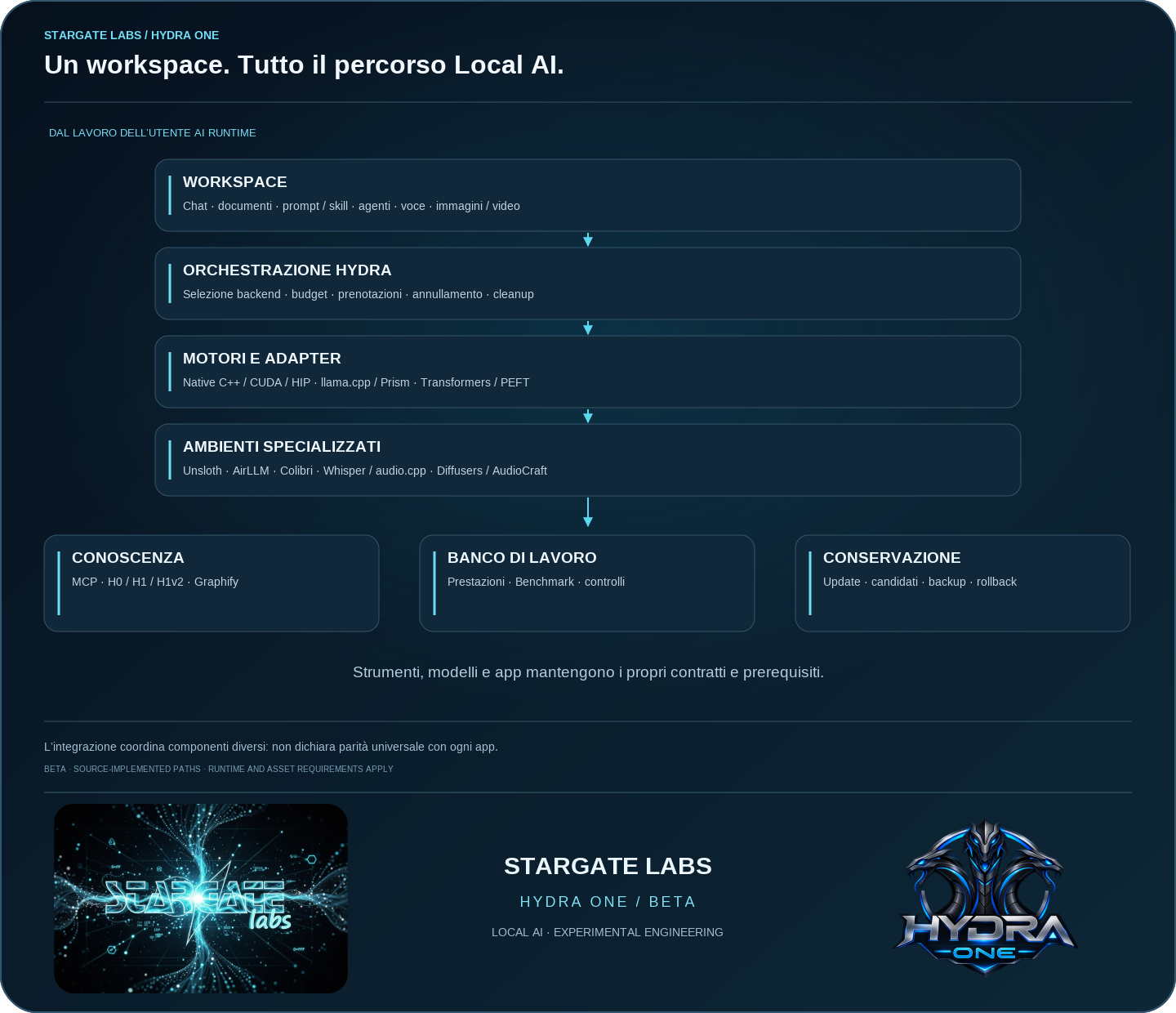
Il controller HYDRA coordina budget, ammissione e adapter; non viene presentato come sostituto universale dei motori tensoriali. Prestazioni, Benchmark e aggiornamenti sono parte dello stesso ciclo di sviluppo, non pagine decorative.
Il percorso di retrieval parte dalle fonti locali autorizzate. H0, H1 e H1v2 scelgono modalità di ricerca differenti; gli embedding richiedono un modello compatibile, Graphify un indice del repository. I passaggi recuperati conservano identità e riferimenti per controllare da dove arriva il contenuto.
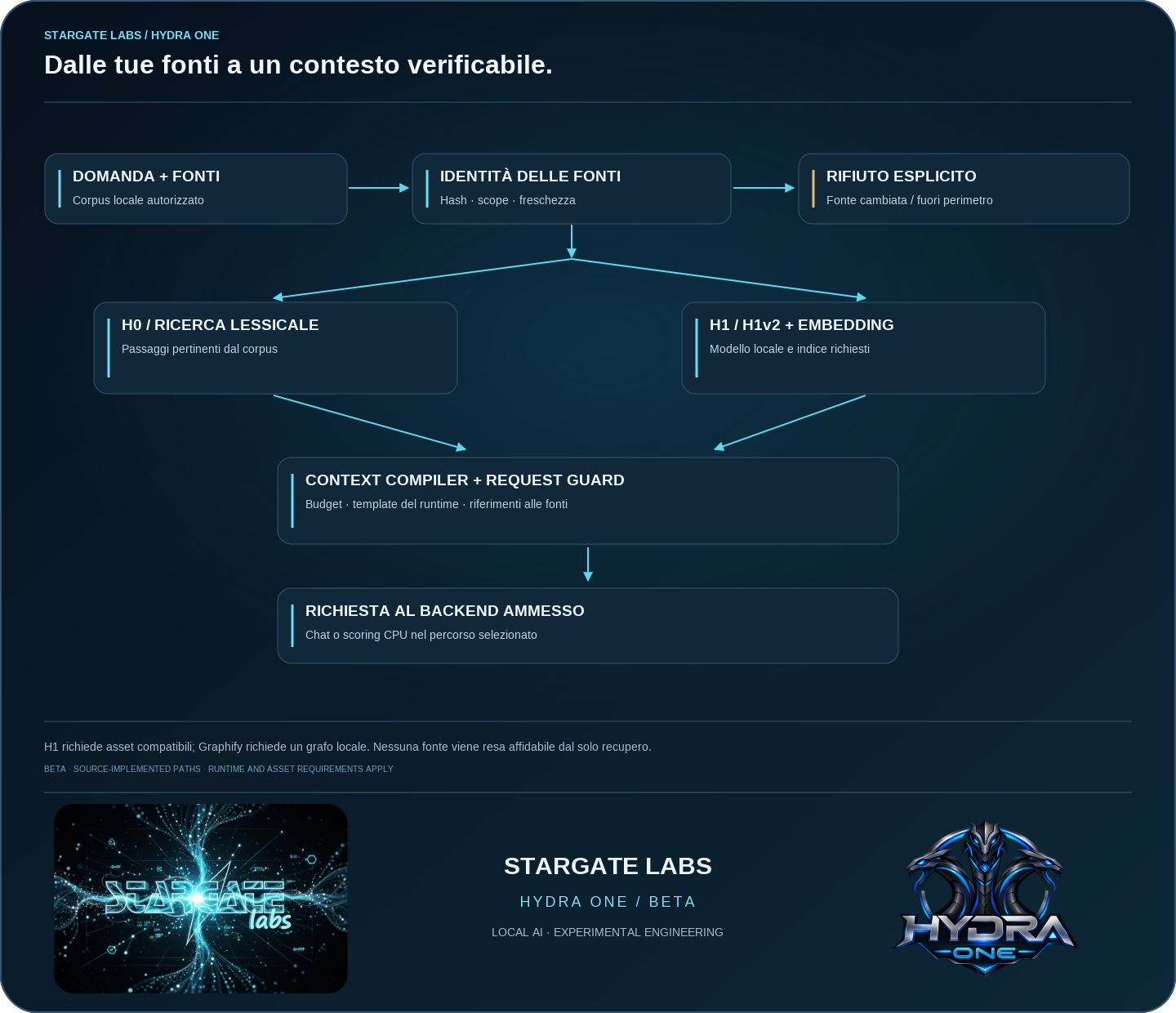
Il compiler prepara il contesto per il frontend del runtime scelto; i guard verificano budget e sorgenti prima dell’invio. Una fonte recuperata non diventa automaticamente attendibile: modifiche, perimetro e freschezza restano condizioni esplicite.
Nel percorso di scoring CPU, più alternative possono condividere lo stesso prefisso. Il checkpoint conserva lo stato nativo ammesso per ripristinarlo prima della valutazione successiva, invece di rivalutare sempre l’intero prefisso quando la cache è disattivata.
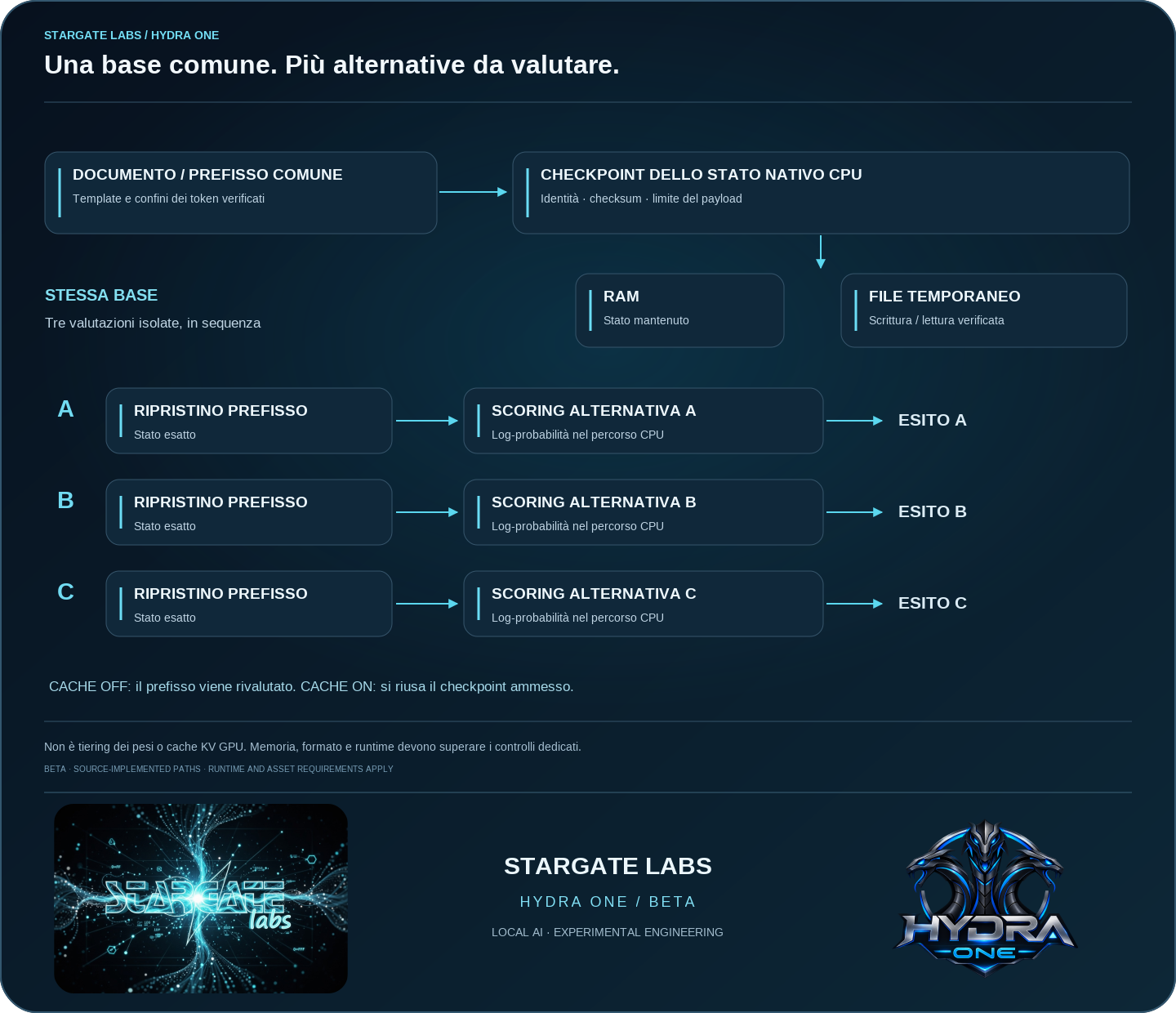
Il payload ha un budget; il supporto può essere RAM o file temporaneo nel percorso previsto. Integrità, ripristino e pulizia appartengono al contratto. È uno stato di prefisso dello scorer: non equivale a offload dei pesi, cache KV GPU o supporto universale di ogni modello.
Il lavoro sul loader riguarda una connessione nativa: le letture devono consegnare byte al consumer del modello e produrre contatori e chiusura verificabili. Il sorgente Prism fissato e gli overlay HYDRA permettono di identificare il percorso compilato.
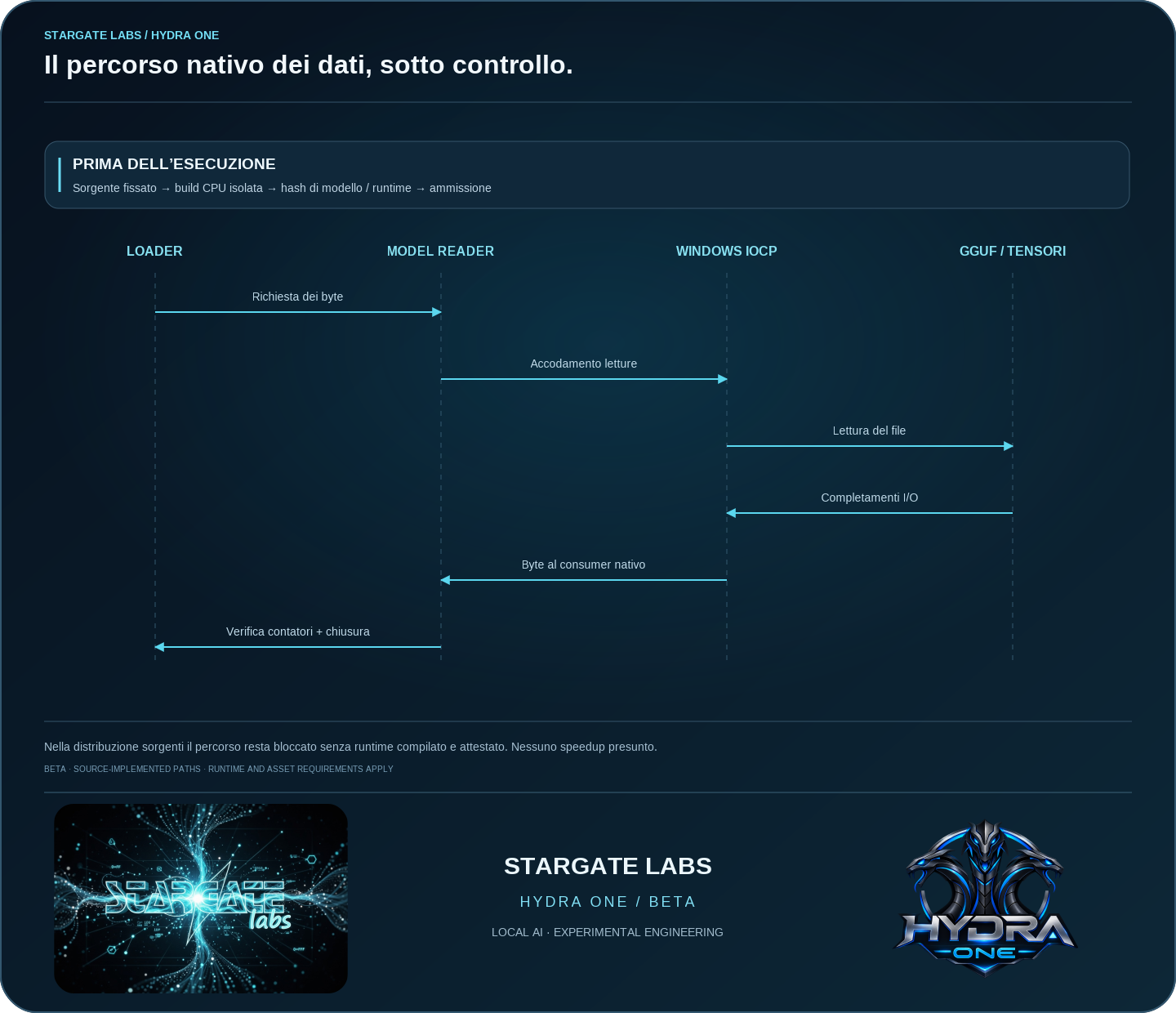
La repository pubblica i sorgenti, non i binari personali già usati sul PC. Per eseguire questa via servono compilazione e attestazione del runtime e del modello. Il confronto con la lettura standard è una prova da misurare: non viene promesso un vantaggio prima del test.
Il banco Prestazioni/Benchmark collega modello, runtime, protocollo e configurazione ai campioni osservati. Il warmup viene distinto dalle misure; output effettivo, annullamenti e fallimenti rimangono parte della storia. Le metriche mantengono il proprio significato: latenza HTTP, TTFT, decode e prefill non sono intercambiabili.
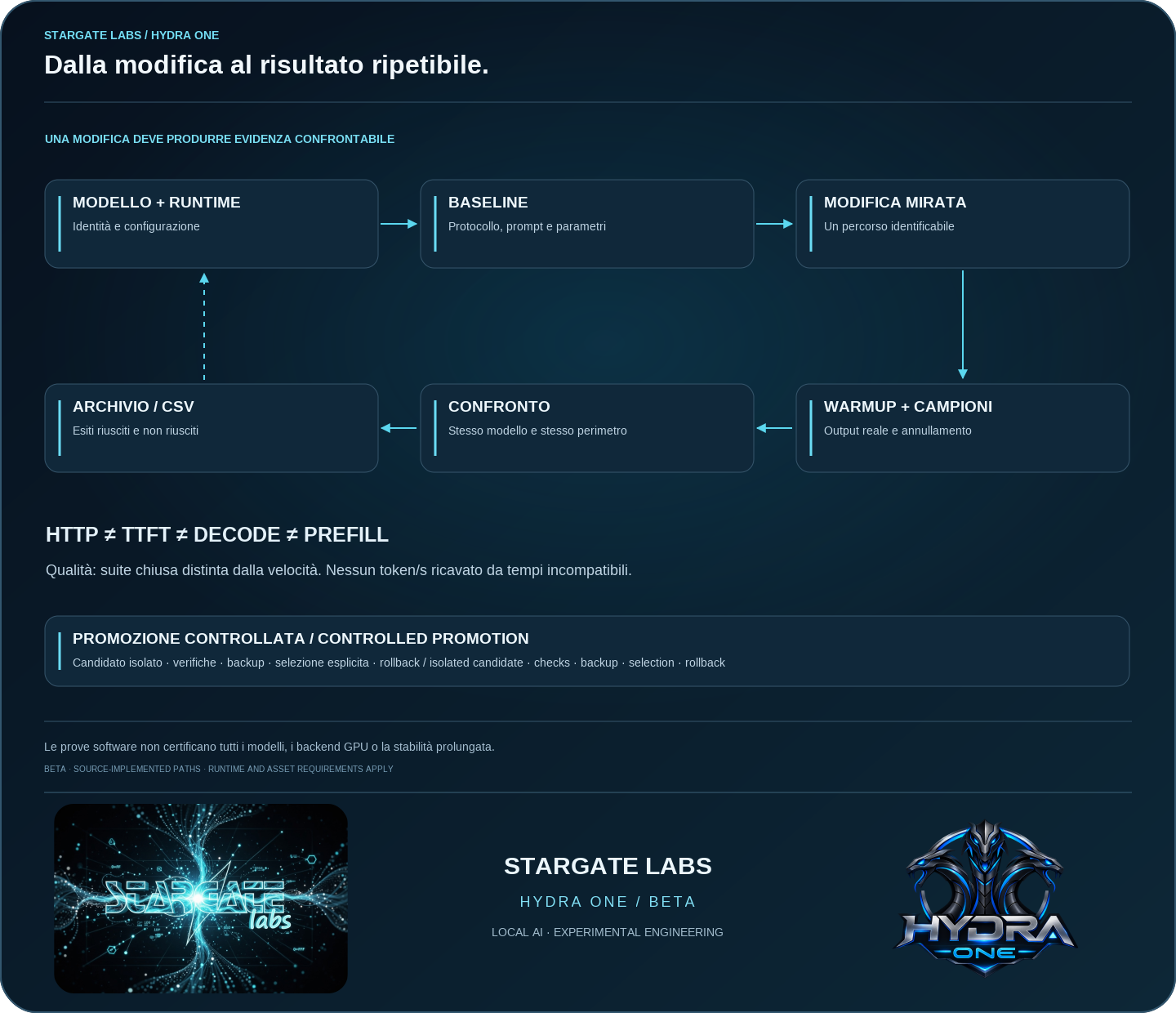
I rapporti confrontabili e l’export servono a decidere se una modifica aiuta davvero. La verifica delle risposte è separata dalla velocità. Il sistema di candidati, backup, selezione e rollback collega questa evidenza alla conservazione della mod, mantenendo i blocchi dei percorsi non ancora ammessi.
llama.cpp Unsloth
 Transformers
 PyTorch
 AirLLM
 Colibri
 Soup
 Whisper.cppaudio.cpp
 VoiceStudio
 OpenVoice
 AudioCraft
 Open WebUI
 OpenCode
 DeepSeek Harness
 TrueForge
 Hermes Agent
 Claude Code
 Playwright
 MCP memory
 Antigravity
 Claude Desktop
Loghi originali. Ruoli e attribuzioni nelle schede sottostanti. Headroom è identificato per nome; non è stato inventato un logo.
Motori, agenti, strumenti e worker presenti nella mod. Ogni scheda indica cosa integriamo e chi ha realizzato il progetto originale.
GGUF engine, native libraries, format tooling and optional server transport.
Selected Python environment, inference/QLoRA integration and owned Studio service.
Local Safetensors text/vision runtime and model metadata integration.
Tensor execution, device/runtime integration and training dependencies.
Optional local layer-streaming backend and isolated runtime selection.
Isolated engine launcher, controls, model routing and System One integration.
Bundled planning modules and managed training integration; original Apache notices retained.
Local ASR and translation. Selected distributions also use the credited Unsloth fork.
Selected local speech runtime. Displayed mark identifies Unsloth, not a separate audio.cpp logo.
Local API/MCP integration, jobs, profiles and rendering workflows.
Optional voice-conversion model/runtime path; task-specific asset checks.
Music and audio generation, conditioning and training adapters.
Original document/OCR/retrieval workers reused by our local adapter; no second dashboard claimed.
Original harness transport, workspace/session integration and candidate updates.
Original harness integration and official package/version mapping.
Harness integration with shared browser/memory services and candidate management.
Original agent integration, project services and isolated source candidate workflow.
Native CLI/harness integration and signed official candidate checks; no claim to redistribute its implementation.
Shared MCP browser service and verified candidate activation.
Shared memory-server contract and project-scoped MCP configuration.
Project-scoped routing metadata, runtime contract and MCP integration.
Hydra One nasce dalle mie esigenze e dal mio modo di lavorare con l’intelligenza artificiale locale. Le scelte, le integrazioni e le funzioni riflettono le mie priorità: possono incontrare le preferenze di altri utenti oppure rispondere a necessità diverse dalle loro. Ho scelto di condividere questo progetto per rendere disponibile il lavoro svolto, favorire il confronto e offrire una base utile a chi desidera esplorarla o adattarla alle proprie esigenze.
Scegli un GGUF o un checkpoint Safetensors, controlla il motore richiesto e avvia il percorso compatibile. I pack nativi e i formati Prism mantengono i propri adapter.
Come è implementatoL’avvio lazy rende disponibile l’interfaccia prima del modello; puoi consultare i pannelli e scegliere quando avviare l’inferenza.
Come è implementatoUsa gli adapter HYDRA, il motore nativo, llama.cpp, Transformers/PEFT, Unsloth, AirLLM, Colibri o un’API locale compatibile, in base alle dipendenze disponibili.
Come è implementatoUsa chat, cronologia e archivio; conserva conversazioni e metadati di organizzazione nell’interfaccia esistente, senza creare una seconda chat parallela.
Come è implementatoIl server espone percorsi compatibili OpenAI e Anthropic per collegare client esterni; gli output strutturati passano da validazione esplicita.
Come è implementatoSfoglia categorie, autori, versioni, varianti e file. Leggi model card, base model e licenza prima di scegliere cosa installare.
Come è implementatoL’inventario locale cerca nelle radici configurate e nelle cache note, distingue i ruoli dei file e riconosce i modelli suddivisi in più parti.
Come è implementatoUsa download con progressi in byte, gestione delle parti e import locali. Disponibilità, spazio e condizioni di accesso rimangono requisiti da verificare.
Come è implementatoIl workspace collega OpenCode, DeepSeek Harness, TrueForge, Hermes e Claude Code ai rispettivi percorsi originali, con gestione delle sessioni e dei candidati.
Come è implementatoCollega servizi MCP configurati e usa i servizi condivisi browser/memoria. Il tool calling resta dipendente dalle capacità del modello selezionato.
Come è implementatoLa biblioteca dell’interfaccia riunisce prompt e skill consultabili nel workspace. La loro presenza non significa che ogni contenuto importato sia un nuovo componente nativo di Hydra.
Come è implementatoImporta PDF, DOCX e testi attraverso il percorso documenti; usa estrazione e OCR quando il runtime e i pesi locali sono disponibili.
Come è implementatoOrganizza raccolte, cerca nella libreria e conserva nome del documento, pagina e posizione. BM25, semantica e fusione ibrida hanno prerequisiti distinti.
Come è implementatoUsa i percorsi H0/H1/H1v2, grafo locale, hash delle fonti e budget del contesto. Le fonti modificate o fuori perimetro vengono gestite dai controlli di ammissione.
Come è implementatoPrepara dataset e parametri espliciti per il training locale; runner, dispositivo, checkpoint e destinazione degli export vengono validati.
Come è implementatoIl codice espone opzioni SFT, DPO, GRPO, KTO, reward e VLM, con restrizioni per runner e dispositivo; non sono tutti percorsi GPU intercambiabili.
Come è implementatoLa conversione GGUF è un lavoro posseduto e annullabile, con risultati persistiti e destinazioni controllate.
Come è implementatoWhisper locale espone impostazioni di decodifica e lingua, segmenti e sottotitoli, usando il modello e il runtime installati.
Come è implementatoUsa il runtime audio.cpp selezionato e i percorsi TTS supportati; il laboratorio include un adapter Kokoro distinto dal caricamento dei modelli chat.
Come è implementatoVoiceStudio collega API/MCP, profili, job e rendering; libreria ed editing audio sono moduli dedicati del workspace.
Come è implementatoAudioCraft e i worker generativi gestiscono i task registrati con modelli e conditioning compatibili; la separazione audio ha un percorso dedicato.
Come è implementatoAssocia un projector GGUF valido o il percorso Transformers vision appropriato. Le capacità dichiarate dal backend determinano l’accettazione degli input.
Come è implementatoI worker Diffusers coprono famiglie esplicite Stable Diffusion, SDXL, inpainting e video. Servono pipeline, pesi e risorse compatibili.
Come è implementatoConfigura ripetizioni, riscaldamento, prompt e budget token. Registra campioni reali, annulla un job e conserva gli esiti nel banco di lavoro.
Come è implementatoConfronta rapporti coerenti e identità dei modelli; separa HTTP, TTFT, decode e prefill. Usa archivio, filtri, grafici ed export CSV per leggere i risultati.
Come è implementatoIl workspace Colibri e i contratti HYDRA distinguono scelta, sì/no, punteggio e scoring dei prefissi. Percorsi e prove non sono dichiarati equivalenti senza una verifica dedicata.
Come è implementatoIspeziona i 59 controlli, dipendenze e parametri; prepara modifiche versionate e mantieni i blocchi per hardware o runtime mancanti.
Come è implementatoMonitor e registri distinguono attività del backend, telemetria del PC e prove storiche. Prenotazioni, annullamento, arresto e idle unload gestiscono i processi posseduti.
Come è implementatoControlla fonti e versioni, prepara candidati isolati, verifica dipendenze e seleziona o ripristina i percorsi supportati senza confondere download e attivazione.
Come è implementatoI backup verificano gli hash dei sorgenti editabili. Il recupero HYDRA ripristina soltanto file mancanti e conserva quelli esistenti modificati.
Come è implementatoController, budget di memoria e adapter nativi: l’esecuzione resta sotto controllo.
Chat, modelli, MCP, benchmark e monitoraggio nella nostra interfaccia locale.
56 funzioni censite con dipendenze, provenienza e blocchi espliciti.
Protocolli, baseline, campioni reali, identità del modello, warmup, TTFT e confronto dei rapporti.
Ricerca, autori, model card, formati, shard, risorse e selezione del runtime compatibile.
Inventario, fonti ufficiali, candidati isolati, backup verificati, selezione e rollback.
Il ruolo concreto di 21 progetti integrati, con marchi originali, sorgenti e attribuzioni.
OpenCode, DeepSeek Harness, TrueForge, Hermes Agent and Claude Code component maps; original transport, sessions and update candidates.
Dashboard, Claude and Antigravity workspace kinds; owned native host and local URL validation.
Project MCP configuration, chat tool bridge, shared browser/memory services and controlled candidate activation.
Playwright MCP and MCP memory server integrated through the shared service configuration.
Project-scoped runtime metadata, routing enablement and MCP launch contract.
Document import, local workers for OCR, semantic processing and reranking. Existing module states no separate Open WebUI HTTP server/UI.
HF search, author/model-card metadata, categories, local discovery, split-file identity, imports and byte-level download progress.
LoRA, explicit SFT/DPO/GRPO/KTO/reward/VLM options; CPU TRL, Soup and Unsloth QLoRA runner policies; checkpoint validation.
Owned cancellable GGUF conversion, dataset upload, output validation and checkpoint/resume handling.
GGUF projector pairing, CPU default and capability-checked GPU offload; Transformers vision paths and multimodal capability reporting.
VoiceStudio jobs/profiles/rendering, local speech, audio library/editing and audiobook planning tests.
AudioCraft conditioning and training, local generative audio, source separation and task-specific capability checks.
Explicit local corpus; SQLite memory, H0/H1/H1v2 graph paths, exact frontend/template reuse, source hashes, freshness and context guards.
56 baseline features plus separate GPU controls; dependency resolution, preview/apply/rollback, execution admission and historical evidence.
IOCP source consumer, CPU scheduling, bounded request-local checkpoints, raw scoring, System One bridge contracts and blocked hardware-dependent paths.
Run history, timing, model/runtime identity, live monitoring, source provenance and explicit task-completion contracts.
Owned children, exclusive GPU leases, cancellation, graceful shutdown, idle unloading and Windows Job limits.
Official source checks, candidate staging, source fingerprints, explicit activation/rollback, dependency supervision and source-only recovery capsule.
OpenAI/Anthropic-compatible server routes, structured response validation, request monitoring and model lifecycle routes.
56 funzioni di base e 3 controlli GPU. Apri una voce per leggere implementazione e vincolo attuale. Le dipendenze hardware e i blocchi restano espliciti.
V7-A-001Backend CPUCONDITIONALHistorical CPU/Vulkan group reconciled: this control gates CPU; GPU backends have separate quarantined controls.
Admission and runtime prerequisites apply
Control: switch
V7-A-002Offload parziale/completo e deviceGATEDnative runtime logs and buffer allocations; CPU and Vulkan paths
QUARANTINED / Partial/full GPU offload and device selection require the separate GPU recovery gate.
Control: switch
V7-A-003Riuso runtime nel benchmark CPUCONDITIONALQwen CPU normal runner:ON keeps one owned runtime across warmup/samples;OFF closes it after each request and reloads serially. Lock remains held through final cleanup. No resident model across independent admissions.
Admission and runtime prerequisites apply
Control: switch
V7-A-004Capability detection e admissionCONDITIONALtest_hydra_start_admission; test_hydra_benchmark_v4; blocked catalog remains separate
Admission and runtime prerequisites apply
Control: mandatory
V7-A-005Circuit breaker e fallbackCONDITIONALtest_hydra_guard_failures; test_hydra_graph_optional; provider-off real 503
Admission and runtime prerequisites apply
Control: mandatory
V7-B-006Prompt cache nativaCONDITIONAL7 cache-enabled native samples; specialized repeated exact prefix; promotion bracket checked
Admission and runtime prerequisites apply
Control: switch
V7-B-007Flash Attention Vulkan off/on/auto (campagna finita)GATEDsingle-variable seven-sample comparison
QUARANTINED / Flash Attention requires an explicit finite v18/v19 campaign and its specific ON control; historical GPU profiles remain quarantined.
Control: switch
V7-B-008Batch e ubatch BonsaiGATEDv6 baseline drift guard; no new Bonsai tuning promoted
QUARANTINED / Prism batch/ubatch experiments require quarantined Vulkan path; historical NO_GO retained.
Control: request_only
V7-B-009Thread CPU e affinitàCONDITIONAL2 threads and owned process affinity verified; thread sweep not performed
Admission and runtime prerequisites apply
Control: switch
V7-B-010Timing nativi e metriche stadioCONDITIONALnative prompt/decode counters; TTFT and pure prefill compute NOT_AVAILABLE
Admission and runtime prerequisites apply
Control: mandatory
V7-B-011Contesto, sampler e seedCONDITIONAL512 context; raw prompt; greedy seed42 max16 frozen across profiles
Admission and runtime prerequisites apply
Control: switch
V7-C-012RAM/VRAM admission e RSSCONDITIONAL12GiB RAM admission; 4GiB VRAM reserve; periodic RSS is not hard cap
Admission and runtime prerequisites apply
Control: mandatory
V7-C-013Checkpoint prefisso scorer CPUCONDITIONALRequest-local native CPU prefix state:checkpoint_tier0=RAM,1=temporary disk file. Disk mode releases retained allocation and restores exact bytes before llama_state_set_data. Exclusive file, checksum, budget and deletion on child exit; no fallback. Not model-weight tiering or cross-request cache.
Admission and runtime prerequisites apply
Control: switch
V7-C-014Budget checkpoint scorer CPUCONDITIONALOwns a bounded request-local native CPU full-state checkpoint for exact prefix reuse across alternatives. Cache OFF re-evaluates prefixes. Not GPU KV, cross-request conversation storage or Colibri state.
Admission and runtime prerequisites apply
Control: switch
V7-C-015Expert cache slot storageGATEDpartial metadata/residency implementation; cache-hit grouped execution not wired; native model pack excluded
BLOCKED / COMPATIBLE_COMPLETE_MOE_TARGET_REQUIRED
Control: request_only
V7-C-016Stato nativo BonsaiCONDITIONALPrism v21 session-local native slot save/erase/restore with model/runtime/session identity, SHA256, disk budget, cancellation and cleanup. CPU continuation restored158337104 bytes and reused22 tokens. GPU also requires a finite grant: native state transfer succeeded but repeated-prefix reuse was0; that mode is refused. Not weight tiering.
Admission and runtime prerequisites apply
Control: switch
V7-C-017Tiering indice GraphifyCONDITIONALOwns repository index data only:0 cold/source disk,1 warm/compressed RAM,2 hot/parsed RAM. Source archive re-read and hashed every request. Not model-weight tiering.
Admission and runtime prerequisites apply
Control: switch
V7-C-018Limite commit Windows obbligatorioCONDITIONALWindows process and aggregate Job commit limits:8 GiB for small-model/functional paths,24 GiB for native families. Flags and limits read back before suspended child assignment/resume. Not an RSS or physical-RAM cap; historical peak-accounting discrepancy retained.
Admission and runtime prerequisites apply
Control: mandatory
V7-C-019OOM e recupero controllatoCONDITIONALbudget/cancellation/error tests with fixtures; no deliberate system OOM
Admission and runtime prerequisites apply
Control: mandatory
V7-D-020H0 lexical SQLite retrievalCONDITIONALtemporary synthetic authorized corpus, hash/scope; real SQLite reads
Admission and runtime prerequisites apply
Control: switch
V7-D-021H1 embeddings localiCONDITIONALlocal CPU encoder and temporary index; provider stopped; historical quality HOLD unchanged
Admission and runtime prerequisites apply
Control: switch
V7-D-022H1 v2 coverage/rankingCONDITIONALreal CPU retrieval; coverage contracts tested; historical quality HOLD unchanged
Admission and runtime prerequisites apply
Control: switch
V7-D-023Context Compiler e RequestGuardCONDITIONALreal graph context fed to Qwen; native tokenizer, one selected node; guards remaining zero
Admission and runtime prerequisites apply
Control: switch
V7-D-024Bypass query breveCONDITIONALCiao uses standard path retrieval_cost_not_justified
Admission and runtime prerequisites apply
Control: switch
V7-D-025Provenienza hash scope freshnessCONDITIONALtest_hydra_graph_memory and optional; tamper/expiry/authorization fixtures
Admission and runtime prerequisites apply
Control: mandatory
V7-D-026Graphify — contesto dal repositoryGATEDSelects current local repository sources for Graph retrieval and Context Compiler; validates source identity and freshness. No GPU/weight acceleration.
BLOCKED / Missing local repository graph: C:\Users\Stargate\Desktop\BattleTron-LSC-smartConnect\.diagnostics\publish\hydra-one\graphify-out\graph.json
Control: switch
V7-D-027Snapshot e invalidazione indiciCONDITIONALHYDRA graph_hybrid and v2 tests; native CPU integration on new corpus
Admission and runtime prerequisites apply
Control: mandatory
V7-E-028mmap vs lettura standardCONDITIONALseven native no-mmap samples versus frozen same workload control
Admission and runtime prerequisites apply
Control: switch
V7-E-029Loader modello Windows IOCPGATEDQwen CPU laboratory only: IOCP delivers actual tensor bytes to llama_file::read_raw in the attested isolated CPU runtime. OFF uses the original reference runtime. Requires mmap OFF; no silent fallback or speedup claim. Applies to new requests after owned cleanup. Bonsai PTQ1_0 CPU uses its separate source-pinned Prism IOCP candidate when its v20 manifest exists; missing candidate fails without fallback. GPU Prism remains standard only. loader_mode:0=IOCP,1=standard reads in the same isolated CPU candidate; both require mmap OFF. Candidate instrumentation is not a speedup claim. V22 prefers source-attested rebuilt CPU candidates for Qwen and Bonsai; changed helper identities fail closed. Rebuild and software checks are not model-loading validation.
BLOCKED / Isolated IOCP CPU runtime not built/attested; no fallback
Control: switch
V7-E-030Linux O_DIRECT/io_uringGATEDWindows host; Linux-specific branches not hardware tested; io_uring not asserted implemented
UNSUPPORTED / Linux-only O_DIRECT/io_uring; Windows environment.
Control: request_only
V7-E-031Prefetch PLE e expert streamingGATEDnative large-pack path not admitted; no weight streaming acceleration claimed
BLOCKED / PRISM_GRAPH_BUFFER_REBIND_API_REQUIRED
Control: request_only
V7-F-032Speculative draft/targetGATEDno admitted compatible draft-target pair and verified backend integration; no second model started
BLOCKED / ATTESTED_DRAFT_TARGET_ADAPTER_REQUIRED
Control: request_only
V7-F-033Graph capture e acceleratori secondariGATEDnative GPU campaigns remain frozen; no supported graph capture test profile admitted
QUARANTINED / GPU graph capture/secondary accelerators not admitted.
Control: request_only
V7-F-034Affinità E-core verificataCONDITIONALSelects up to two allowed group0 E-cores using Windows efficiency classes. Applies and reads back process affinity before child resume. OFF preserves normal adapter affinity; no speedup claimed.
Admission and runtime prerequisites apply
Control: switch
V7-G-035Riuso HTTP server testuale CPUCONDITIONALOne connection and one in-flight request per native template-aware CPU server. Only fully consumed JSON responses reused; partial/SSE connections discarded. No automatic retry. Connections close at runtime cleanup.
Admission and runtime prerequisites apply
Control: switch
V7-G-036Pipeline distribuita e shard stagingGATEDno dedicated remote nodes authorized; production Ubuntu untouched
BLOCKED / AUTHORIZED_NODE_EXECUTION_ADAPTER_REQUIRED
Control: request_only
V7-G-037Connection loss e timeout trasportoCONDITIONAL8 transport tests including controlled errors; no LAN stress
Admission and runtime prerequisites apply
Control: mandatory
V7-H-038Text generation appCONDITIONALsmall Qwen real CPU/Vulkan generation and graph requests
Admission and runtime prerequisites apply
Control: switch
V7-H-039Scoring raw continuazioniCONDITIONALreal native CPU scorer; blue/red one token, long two tokens; all scored finite sums/means; child exit0; raw only, no System One parity
Admission and runtime prerequisites apply
Control: switch
V7-H-040TTS KokoroCONDITIONALnew measured WAV and separate warmup, app registry PASS; old timeout preserved
Admission and runtime prerequisites apply
Control: switch
V7-H-041Vision grounding LocateAnythingCONDITIONALreal synthetic geometry input and valid bounding boxes; semantic quality limited
Admission and runtime prerequisites apply
Control: switch
V7-H-042Image Z-Image TurboGATEDvalid generated PNG 256px two steps; pipeline/backend logs preserved
QUARANTINED / Image adapter executes Vulkan diffusion even with CPU weight placement.
Control: request_only
V7-H-043Music YuE2CONDITIONALreal short generated WAV and symbolic artifact if emitted; native validation
Admission and runtime prerequisites apply
Control: switch
V7-H-044Bridge domande isolato CPUCONDITIONALSystem One-shaped noul/choice/score requests executed by HYDRA native Qwen CPU scoring. Explicit tokenizer/model provenance. No System One contact, Colibri boundary or semantic parity claim; pinned cache unsupported.
Admission and runtime prerequisites apply
Control: switch
V7-H-045Scoring CPU con prefisso esattoCONDITIONALNative Qwen C API scoring of exact UTF8 prefix plus ordered continuations. No strip, NFC or implicit template. Actual token boundary checked; incompatible continuations return unscorable_boundary. Original fixture-only contract retained separately.
Admission and runtime prerequisites apply
Control: switch
V7-H-046Colibri 35B GS64 modelGATEDmemory and live tokenizer identity/boundary gates remain BLOCKED; no loading
BLOCKED / FULL35B_RUNTIME_IDENTITY_AND_MEMORY_MANIFEST_REQUIRED
Control: request_only
V7-I-047Exclusive lock e reservationCONDITIONALcross-workspace lease, cancellation and admission tests; real serial runs cleanup
Admission and runtime prerequisites apply
Control: mandatory
V7-I-048Cancellation e timeout childCONDITIONALcontrolled child/fixture tests; old failures retained; no global process-name termination
Admission and runtime prerequisites apply
Control: mandatory
V7-I-049Publication after cleanupCONDITIONALRED 3 failures then GREEN; native Locate post-fix verification; shared runner/audio fixed too
Admission and runtime prerequisites apply
Control: mandatory
V7-I-050Execution identity e immutable eventsCONDITIONALidentity and registry tests; previous rows checked canonical digest
Admission and runtime prerequisites apply
Control: mandatory
V7-I-051Routing/planner research variantsGATEDbaseline, causal, mixed, one research suites; not native generation acceleration
UNSUPPORTED / Routing/planner research variants are software-only; no new runtime dispatcher.
Control: request_only
V7-J-052Benchmark persistent history/exportCONDITIONALowned app restart verified records; actual SQLite JSON/CSV export
Admission and runtime prerequisites apply
Control: mandatory
V7-J-053Monitor live feedCONDITIONALreal runner feed producer and software integration; browser visual check unavailable
Admission and runtime prerequisites apply
Control: switch
V7-J-054Grafici delle prestazioniCONDITIONALControls optional charts in the existing page. Safety controls and history remain available.
Admission and runtime prerequisites apply
Control: switch
V7-J-055Catalog asset/runtime compatibilityCONDITIONALcatalog evidence state independent of CANCELLED/metadata failure; 16 identities retained
Admission and runtime prerequisites apply
Control: mandatory
V7-J-056Lab OFF isolamento operativoCONDITIONALopt-in contracts; no startup/default/router/System One modifications
Admission and runtime prerequisites apply
Control: mandatory
runtime.vulkanBackend VULKANGATEDErrorDeviceLost cause UNKNOWN; GPU quarantine
QUARANTINED / ErrorDeviceLost cause UNKNOWN; GPU quarantine
Control: request_only
runtime.hipBackend HIPGATEDHIP compiled, GPU inference not admitted
QUARANTINED / HIP compiled, GPU inference not admitted
Control: request_only
runtime.cudaBackend CUDAGATEDCUDA toolkit nvcc unavailable; GPU quarantine
QUARANTINED / CUDA toolkit nvcc unavailable; GPU quarantine
Control: request_only
Questi controlli verificano il software indicato nel report; non sono benchmark GPU o una certificazione di ogni modello. I limiti sperimentali sono documentati.
Sorgenti Ubuntu sperimentali · Prerequisiti e limiti nella repository.
Hydra One è basato su Strata di Niko1221 e collaboratori, con le nostre modifiche locali e l’integrazione HYDRA. Copyright, licenze e contributi originali restano attribuiti.